
Astronomical tourism in the Primorsky Territory
Опубликовано: 22.10.2026
The night sky of the Far East fascinates with its brightness and depth. Far from the lights of major cities, the endless space opens before travelers: scattering of distant galaxies, shimmering constellations and a silvery strip of the Milky Way. Astronomical tourism in Primorsky Krai is popular among those who are looking for unusual experiences and seek to escape from the daily bustle of the city.
Primorsky Krai offers ideal conditions for those who are attracted by practical astronomy and the romance of night discoveries. Sea coasts, high hills and remoteness from the light of major cities create an excellent environment for researchers of the night sky. Our guide will tell you where to find the most interesting locations, how to prepare for a night trip and how to catch a bright autumn starfall.
Primorsky Krai is a region for astrotourism
More and more travelers visiting Primorsky Krai, choose an unusual format of country recreation - watching the stars. Primorye differs favorably from many other regions of the country by a rare combination of climate and relief:
- Pure and transparent autumn air provide high optical stability of the atmosphere without thermal distortion.
- Mountain ranges Sikhote-Alinya and coastal capes harmoniously from the wilderlands of the world.
Here, everyone can feel like a discoverer of the universe, watching the movement of distant planets and bright comets.
Where to see the starry sky in the Primorsky Territory
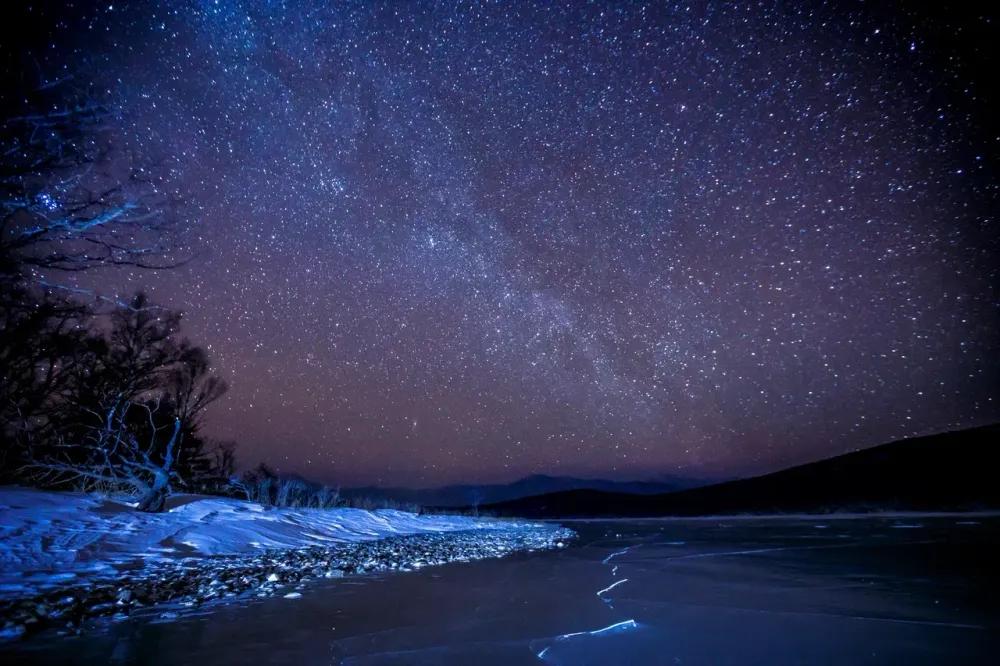
The main enemy of any astronomy enthusiast is the artificial lighting of cities. If you are looking for a place to see the starry sky in its pristine splendor, head away from Vladivostok and other major cities. Maps of light pollution show: already an hour and a half drive from the capital of the region, the so-called “gray” and “blue” zones begin, where street lights do not interfere with the night view. Travelers are often interested in where you can see the starry sky with maximum comfort and a beautiful view:
• Observatory "Primastro" and the village of Gornotazhnoye. Historical Center for Astrophysical Research of Primorye near Ussuriysk. Telescope domes are installed here, and specialists regularly conduct informative excursions for guests.
• Cape Tobizin on Russky Island. The nearest point to Vladivostok with an open southern horizon. The cliffs go far into the sea, so the light of the metropolis reliably hide the hills behind their backs.
• Gamov Peninsula and Telyakovsky Bay. The southern part of the Khasansky District is renowned for its pristine, dark skies. White granite cliffs and the silhouettes of relict pines create a fantastic foreground for panoramic views.
• Anuchinsky and Chuguyevsky districts. The deep Ussuri taiga and the spurs of the Sikhote-Alin mountain range ensure a perfectly black horizon, free from any light domes.
For parking, choose open elevations or coastal cliffs facing south and east. It is there that the best view of the central arms of the Milky Way and the rising constellations opens.
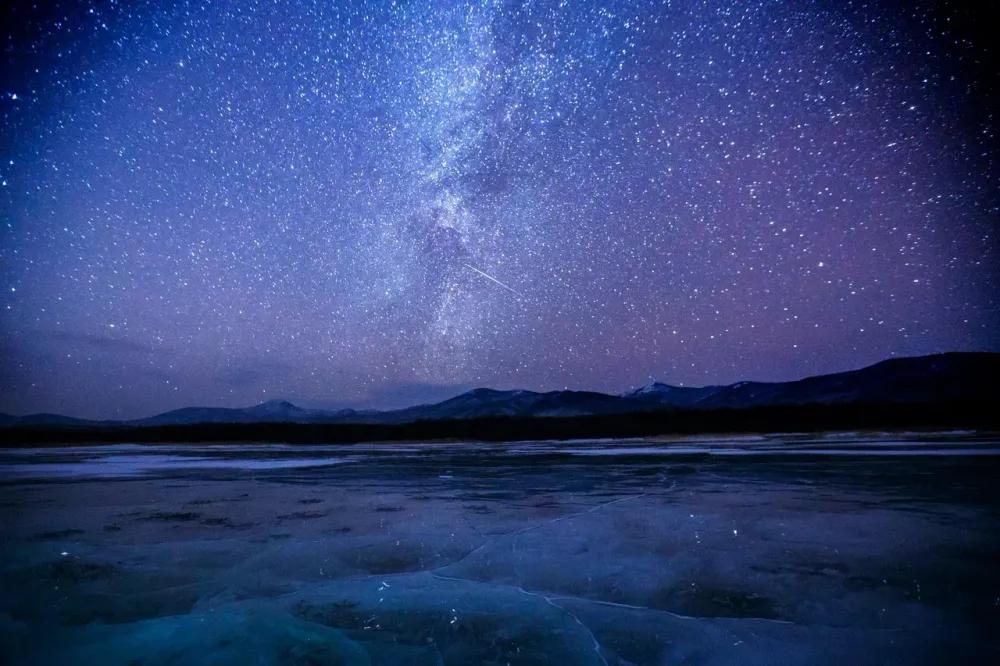
Starry Sky in October: constellations, planets and autumn space in Primorsky Krai
Mid of autumn is a great time for fans of observations in the south of the Far East. Monsoon cyclones finally retreat, giving way to stable anticyclones with a clear night sky. During this period, stars are pleased with the excellent visibility of bright clusters and distant galaxies.
In the clear autumn sky, a large-scale sky panorama unfolds:
- The summer-autumn triangle of the stars Vega, Deneb and Altair smoothly slopes to the west, giving way to the constellation of Taurus and the shimmering Pleiades.
- The Andromeda Galaxy is visible to the naked eye in the form of an oblong misty spot.
- The figure of a celestial hunter rises closer to midnight in the east - the constellation of Oregean and the open sea.
A tip for travelers: October nights by the open sea can be freezing. Be sure to wear sturdy, warm footwear with thick soles, and bring a windproof jacket, gloves, and a thermos filled with hot, sweet tea.
The best time for in-depth observation begins around two in the morning, when the atmosphere has finally cooled and stabilized, and the last shop windows and streetlights in the coastal villages have gone dark.
Meteor stream of Orionids: the main starfall of autumn 2026
In October, you can observe one of the most spectacular astronomical events of 2026 - the Orionid meteor shower. This is a periodic meteor shower generated by the dust plume of the famous Halley Comet. Earth’s orbit crosses this trail every year, and tiny particles of cometary matter burn up in the upper atmosphere at tremendous speed.
Autumn starfall Orionids is characterized by fast white meteors, which often leave behind glowing traces in the sky:
- The radiant stream is located in the constellation Orion, just above and to the left of the bright star Betelgeuse.
- In 2026, the peak of activity falls on the night from 21 to 22 October, when the intensity reaches 20-25 meteors per hour.
- The speed of particles is about 66 kilometers per second, so bright strokes last for fractions of a second.
Observing the famous Orionid starfall in October is most convenient without optical devices. The human eye covers a much wider field of view than binoculars or a spyglass. It is enough to recline in a comfortable tourist chair, direct your eyes to the southeastern part of the sky and be patient.

How to organize astronomical observations and astrophotography
Quality astronomical observations require competent preliminary preparation. To bring the maximum impressions, coordinate your dates with the lunar calendar. A bright full moon is able to illuminate the faint glow of nebulae no worse than streetlights, so plan departures for the phases of the new moon or the first quarter. A few simple rules will help make your adventure as comfortable as possible:
- Download the mobile planetarium in the app store to easily navigate among the constellations in place.
- Use a flashlight exclusively with a red filter: a bright white beam instantly knocks out night vision, the restoration of which takes the eye about twenty minutes.
- To shoot the night sky, use a strong tripod, a high-speed wide-angle lens and manual focus mode on a bright star.
Astrophotography can be done without expensive equipment: a modern smartphone with night shooting mode is enough. The main thing is to securely fix the phone on a tripod and set a long shutter speed for 15-20 seconds. Slowly observing the stars in the taiga or near sea rocks gives a deep sense of peace and harmony with the world. Go to meet the shooting stars, explore the night sky and discover the pristine beauty of the Far East with Visit Primorye