
Walking along Svetlanskaya Street
The main historical artery of the city - Svetlanskaya Street - keeps the spirit of free porto-franco, merchant secrets and sea glory of Primorye. Fascinating walks around Vladivostok allow you to transfer to the turn of the XIX-XX centuries in a couple of hours, admiring the elegant facades in the style of Art Nouveau, Neo-Gothic and Russian narrow.
The rich history of Svetlanskaya Street is inextricably linked with the development of the military fleet in the Pacific Ocean: once it was called American, but was solemnly renamed in honor of the sailing and screw frigate Svetlana. Today, the key attractions of Svetlanskaya are concentrated here - ancient mansions, monuments to the discoverers, shady squares and legendary shopping passages.
Itinerary programme
The square named after Admiral Nevelsky is a landmark historical space on the natural elevation of Svetlanskaya, from where a magnificent view of the Golden Horn Bay opens. It was on this slope in 1897 that the very first monument of Vladivostok was solemnly opened, dedicated to the outstanding researcher who proved the island position of Sakhalin and explored the lower reaches of the Amur.
- The Nevelsky Monument - a strict granite pyramid crowned with a double-headed eagle with a bronze bas-relief of the admiral and a laconic quote of Emperor Nicholas I.
- Shady alleys of century-old trees with comfortable benches for relaxing overlooking the roadstead and warships.
- Panoramic observation decks, perfect for photos of the Golden Bridge.
This secluded green space offers a pleasant rest before a busy route through the city center. The square harmoniously combines the memory of great geographical expeditions with the leisurely resort rhythm of modern Vladivostok.
 Памятник Г.И. Невельскому. Фото: Игорь Онучин
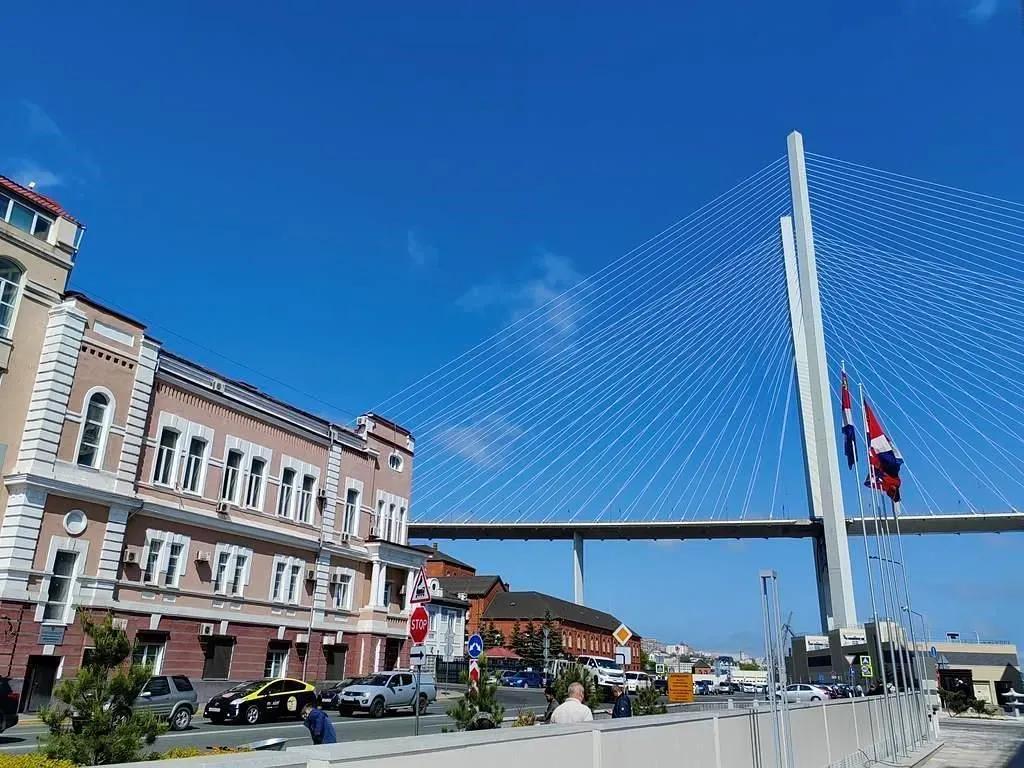 Золотой мост

Admiral Square is one of the oldest park corners of the city, laid down by officers and sailors of the Siberian Military Flotilla at the dawn of Vladivostok. The territory of the square smoothly descends from Svetlanskaya Street directly to the Ship Embankment, forming an expressive memorial and walking ensemble.
The space of the square unites architectural and historical monuments of different eras:
- The triumphal arch of Tsarevich Nicholas is a recreated ceremonial royal gate in an elegant pseudo-Russian style.
- The elegant chapel of St. Andrew the First-Called with a golden dome.
- The monument to the holy hero Ilya Muromets - the heavenly patron of the border troops of Russia.
Strolling along granite stairs in the shadow of spreading crowns, pay attention to the fountain in the form of a fabulous sea shell. This is a popular holiday destination for citizens and an excellent location for expressive memorable shots.
 Храм часовня святого апостола Андрея Первозванного. Фото: Дарья Агафонова
 Адмиральский сквер. Фото: Дарья Агафонова
 Памятник святому богатырю Илье Муромцу. Фото: Игорь Онучин
 Николаевские Триумфальные ворота

The monumental building of the post office on Svetlanskaya, erected at the end of the XIX century by the architect Alexander Gvozdiovsky, immediately attracts the eye with the original Russian-Byzantine style. The expressive facade of locally produced dark brick, massive semicircular windows and decorative turrets make it a real masterpiece of Far Eastern eclecticism.
The historical complex of the Main Post Office is remarkable not only for its external architecture, but also for its rich chronicle:
- The building has been continuously serving as the main post of the city for more than a hundred and twenty years.
- It was from here that telegrams began to be transmitted by direct wire to St. Petersburg for the first time in Vladivostok.
- The internal operating room preserved the authentic pre-revolutionary layout and strict departmental aesthetics.
Look inside to send your family a branded postcard with views of Vladivostok from the historical heart of the city. Be sure to appreciate the skillful curly masonry of cornices and forged lanterns at the front porch.
 Здание Владивостокской почтово-телеграфной конторы. Фото: Игорь Онучин
 Памятник Элеоноре Лорд Прей. Фото: Игорь Онучин

The elegant four-storey mansion of the former hotel "Central" on Svetlanskaya is a magnificent example of commercial architecture of the heyday of modernity. At the beginning of the XX century, this luxurious hotel was deservedly considered one of the best on the Pacific coast: foreign diplomats, gold miners, naval officers and touring artists stayed here.
The appearance of the historic building delights with calibrated proportions and decorative accents:
- Figure balconies with openwork metal weaving and embossed corner bay windows. Smooth plant motifs of stucco decor, characteristic of classical Art Nouveau.
- High arched windows of the first floor, where luxury shops and a restaurant worked before the revolution.
Today, the restored building carefully preserves the historical appearance and decorates the perspective of the street. Looking at the subtle details of the facade, it is easy to imagine the noisy atmosphere of the young port city during its golden age
 Бывший отель «Централь». Фото: Игорь Онучин
 Фото: Игорь Онучин
To complete a walking tour of Svetlanskaya stands at the main building of the Museum-Reserve of the History of the Far East named after V. K. Arsenyev. The museum occupies a luxurious three-storey building of the former profitable house of merchant Vasily Babintsev. Its exposition is recognized as one of the richest in the region and tells in detail about the dramatic development of the Pacific frontiers of Russia.
In the spacious halls of the museum unique world-class relics are collected:
- Archaeological treasures of the medieval states of Bohai and the Zhurzhen Empire.
- The richest ethnographic collections dedicated to the life and beliefs of the indigenous peoples of Primorye - the Udegeians, Nanais and Tazovs.
- Personal diaries, manuscripts, expedition equipment and rare photographs of Vladimir Arsenyev himself.
Allow at least an hour and a half to explore the exhibition. Interactive displays, modern multimedia screens, and authentic artifacts will help bring together the full spectrum of centuries-old Far Eastern history.


